Recent discussions about objectification of women in comics have tended to bring up the corollary question of whether men are equally objectified in comics, and if that isn’t “just as bad.” I think we’ve all seen the remixed covers by now that feature the Green Lantern’s Power Battery among other heroes’ attributes. Alas, it is but a dream, a hoax, an imaginary story. Truly it takes more than spandex over muscles to bring the objectification even close to in line with the way that women are presented by default (two of the most important words to remember in discussions such as this) on the comics cover/page. But is it even possible? Certainly the remixed covers provide a good place to start, but even they don’t go far enough. So I thought I’d start to whip up a list of other criteria that would need to be met prior to my being able to accept that men are just as objectified, and that said objectification is just as bad as that of women (and as a note, I’ll add that the dynamics I envision in this list are hetero, for the sake of simplifying the discussion)…
IF…every drawing of a man, even the civilians and background characters, put him in an outfit meant to show off as much of his body as possible, and
IF…every panel in which such a man appeared had him striking some kind of pose meant to show off his body in a sexual way, no matter how awkward and inappropriate to the situation, for example showing off his ass and (ample) package at the same time, regardless of comfort or practicality, and
IF…every time a man threw a punch or a kick, the angle of the image were sure to draw attention to the ass or package, and
IF…men’s costumes were frequently designed to draw as much attention to the penis as possible, while still keeping it covered up, and
IF…at least some men took it upon themselves to go out fighting crime in a thong (hey, it’s no less impractical than when a woman does it…), and
IF…when anticipating getting into a fight, men would slip casually into a contrapposto and still manage to flex something, and somehow land a punch, and
IF… when coming up with examples of cheesecakey exploitation, Gogo Fiasco was just as likely to come to mind as Vampirella, and
IF…in the fan press you would constantly see references to male heroes who are hot and by the way kick ass, with hotness always coming first,
Even then, the objectification wouldn’t be as bad, unless we could say in real life that…
The first measure of men’s worth is how attractive and presumably available they are for women’s use, and
Whenever we see a movie or music magazine with a male celebrity on the cover, he is coyly looking at the camera while pulling his untucked shirt suggestively over his hip, showing off the skin, and
When making a list of the accomplishments and non-physical qualities of a man, we are expected, by default, to add “and he’s hot/easy on the eyes/whatever too!” and if we don’t it is presumed that he is ugly and the previous list of traits is mere compensation for that fact (and it matters), and
On and on…
Anyway, this could obviously be one hell of a list were I not so pressed for time, so hey, feel free to add more in the comments! I know my list is far from complete.
Monday, May 15, 2006


Wednesday, May 03, 2006
This Cannot Get Buried
This is too important to allow it to be eclipsed by certain other also-important subjects. Lea Hernandez is starting a grant program to help women who want to make comics on their own terms and still make them available to people to read. Here's the goods:
In order to foster women publishing independently, with economy, and as owners of what they create, I will award three grants annually, of a year's free hosting at WebComicsNation.com, to women making webcomics. The recipients will have unlimited data storage and bandwidth, the ability to choose to support their work with ads, and a storefront for selling merchandise.Being able to make comics at no cost to yourself is like the equivalent of getting paid at any other job, so this is a big deal. Keep an eye out for the details, which should be coming next month. Lea's got a good eye for talent, as evidenced by the Girlamatic roster, so these recipients should really be people to watch. Another thing that'll be fun to watch is when guys start complaining that it's only available to women. Yeah, I wish I could believe that wasn't going to happen, too.
Tuesday, April 11, 2006
And if you think I was pissed before...
Dammit! I just got done baking up a huge batch of chocolate cupcakes with cream cheese frosting when I realized that after tomorrow night I can't eat them. Stupid Egyptians stupid enslaving my stupid people. I really, really, really do not do well this time of year (and I always cheat about five days in anyway, but this is my year, man).
Call for Donations; Also, Thoughts About the Club
I meant to post on this a couple of days ago when I first saw it on Lea Hernandez's Livejournal, but I've got some time now, so I'm joining the chorus (like you knew I would). The Friends of Lulu organization has started to raise funds to provide legal assistance to victims of sexual assault within the comics community. They are taking money donations over at empower at friends-lulu dot org. Also, they may be interested in artwork or collectible items, and you can send an email to ronee at friends-lulu dot org to ask about those kinds of donations. Then head on over to Buzzscope, where the victim of the case that inspired all this way back when steps forward and identifies herself, explaining what happened. From a legal standpoint, it seems pretty complicated, and given the number of times this type of thing probably happens, I can only think that this fund is a good thing. Increased awareness of how to navigate the complex legal issues surrounding these kinds of cases removes one weapon from the arsenal of the abuser, and makes the environment less hospitable for them.
Which brings me to my next point: the hospitable environment needs to go away. Why aren't the gropers the ones forced to scrounge for change to find legal representation? Why, if it's such a small and maladjusted minority doing these things, do they feel as though they are in a space where it is safe to do it in the first place? And why are they right?
I know, I know, it's a boys' club, and the world is a boys' club. But it is important to mark off some territory that is hospitable to decent folks just trying to do their thing, and that means all decent folks, and that will only come with open hostility to those who think it's okay to display harrassing behavior at conventions or over email or in weblog comments; those who think it's okay to go on a message board and make rape threats (yes, even if they think it's a joke); those who make creepy comments about how hot a creator is as though that has anything to do with anything, and then stare lewdly at them in their convention booths; those who get gropey at convention gatherings (camera phones, people. I can't stress their value enough); those creators who try to get a feel off of their fans or otherwise make lewd remarks. These are not the kind of things that basically decent people do in good fun, and they're honestly not the kind of things those of us who are far from decent do in good fun, either. It's what nasty, creepy people do, and I'm tired of accomodating them and living with the hostile environment that they create, and that is maintained by those who are willing to give it a pass because c'mon, it's not like they're hurting anybody. For once, can't they be the ones who have to crawl off to clandestine spaces in order to soothe each other? Can't they be made to feel that fandom and the industry (for God's sake, the professional industry!) are hostile to them?
Comics, SF, fantasy, gaming and like fandoms/industries attract a good number of women, and in fact a good number of feminist women. And you know, there's something about it, and I don't know what it is, but I like it, and I keep coming back to the idea that it's a good place to dig in and insist on change. Maybe it's just a small enough space for such a reversal to work, for the focus of the hostility to shift from women to those who make the environment inhospitable to women. And maybe contributing to this fund is a good place to start, but no, an even better place to start is that when someone tells you a story about an incident happening to her, or about a situation making her feel uncomfortable, believe her. Don't "withhold judgment" until you have "all the facts" or any such nonsense. Just believe. It's easy and you're not out anything by doing it. Believe, but also donate, if you can. Yeah, believe and donate. That'd be awesome.
Which brings me to my next point: the hospitable environment needs to go away. Why aren't the gropers the ones forced to scrounge for change to find legal representation? Why, if it's such a small and maladjusted minority doing these things, do they feel as though they are in a space where it is safe to do it in the first place? And why are they right?
I know, I know, it's a boys' club, and the world is a boys' club. But it is important to mark off some territory that is hospitable to decent folks just trying to do their thing, and that means all decent folks, and that will only come with open hostility to those who think it's okay to display harrassing behavior at conventions or over email or in weblog comments; those who think it's okay to go on a message board and make rape threats (yes, even if they think it's a joke); those who make creepy comments about how hot a creator is as though that has anything to do with anything, and then stare lewdly at them in their convention booths; those who get gropey at convention gatherings (camera phones, people. I can't stress their value enough); those creators who try to get a feel off of their fans or otherwise make lewd remarks. These are not the kind of things that basically decent people do in good fun, and they're honestly not the kind of things those of us who are far from decent do in good fun, either. It's what nasty, creepy people do, and I'm tired of accomodating them and living with the hostile environment that they create, and that is maintained by those who are willing to give it a pass because c'mon, it's not like they're hurting anybody. For once, can't they be the ones who have to crawl off to clandestine spaces in order to soothe each other? Can't they be made to feel that fandom and the industry (for God's sake, the professional industry!) are hostile to them?
Comics, SF, fantasy, gaming and like fandoms/industries attract a good number of women, and in fact a good number of feminist women. And you know, there's something about it, and I don't know what it is, but I like it, and I keep coming back to the idea that it's a good place to dig in and insist on change. Maybe it's just a small enough space for such a reversal to work, for the focus of the hostility to shift from women to those who make the environment inhospitable to women. And maybe contributing to this fund is a good place to start, but no, an even better place to start is that when someone tells you a story about an incident happening to her, or about a situation making her feel uncomfortable, believe her. Don't "withhold judgment" until you have "all the facts" or any such nonsense. Just believe. It's easy and you're not out anything by doing it. Believe, but also donate, if you can. Yeah, believe and donate. That'd be awesome.
Friday, March 31, 2006
Musings on Jog, Dworkin, and Vampirella
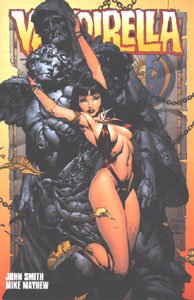
I can obsessively stew over things for weeks at a time, turning them around in my head and examining them, talking to myself about them and generally driving myself and my loved ones crazy. So it has been with a post I read over at Jog’s a few weeks ago, specifically a review of a Vampirella collection. See, at the time I read it, I was had also just discovered Andrea Dworkin’s web site which is, for one such as myself, a gold mine of brainfood (not as good for the heart, as it turns out, but necessary). I have also been making my way through Julia Kristeva’s essay “Women’s Time” which I can only presume influenced my reading of Jog’s post and the thinking that resulted. Folks know me as a comics nerd, but I am also quite the feminism nerd—though “nerd” maybe implies that my interest is more in scholarship and cataloguing than in justice, which, well, isn’t true, but I don’t know of any way to fully convey my enthusiasm for sexual justice other than to call myself a nerd for it, so there it is. Right.
My regular reading audience will know, of course, what Vampirella is, but for those who don’t know, or can’t infer from the title, it is a pulpy cheesecake horror comic best known for its protagonist of same name who is a busty, floss-clad, black-haired, often chained to something vampire alien woman. So Jog is reading along in this collection of comics from the mid 90’s, when he notices something kind of odd:
"But a little something’s missing - any actual sex or nudity, of course! Indeed, these stories will often go to laughable lengths (not just carefully positioned arms or shadows, but women walking around at an orgy wearing pasties) to avoid showing so much as a single nipple, despite their overwhelming desire to appeal to the most low-down needs of the readership. After all, this is a work where a sixteen-year old girl responds to the death of her father by squeezing her body into a skintight catsuit with the front zipper down to just above her navel, and where the title heroine at one point struts around in a revealing new costume just for the sheer hell of playing dress-up - she never actually uses it.[...] It’s the most puritanical work of sequential prurience I can readily think of at the moment, and that attitude even extends to the very suggestion of sexual activity. In the interview, Morrison makes mention of the "weird sex in the 90s" he’s been getting into, which attracted him to the book; funny then that the only characters in this book that enjoy any (carefully obscured) sex are the villains, who are then summarily massacred."
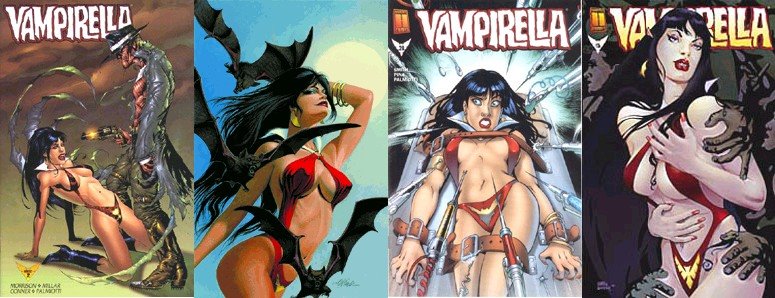
So why, if it is primarily meant to be a T&A book, does it so staunchly refuse to portray any actual nudity or sex? What is the goal, exactly, in keeping things covered up, despite the bodily contortions, the bindings, the violence? As Jog says,
"Actually, Vampirella manages to get chained down or tied up or otherwise restrained at least once in every story in this book, her dental floss-clad form writhing in chop-licking detail."At first blush, this might seem like a dissonance, like these things are working in contradiction with each other. But then I got to thinking about how, in the case of this character, the only clothing present has the explicit purpose of just obscuring the nipples and pubic area. And it was during this time that I ran across Dworkin’s essay “Vargas’ Blonde Sambos.” The essay itself is about WWII-era cheesecake good girl art, but I swear she could have been reading comics in the 90’s. For example, about the revealing clothing she says,
"There is a strategy, propagandistic, not artistic. That which is covered exposes the nakedness underneath."It is entirely possible that the wisps of clothing serve to focus attention on, rather than away from, the covered areas. And of course there is a long history in art, as in life, of women being forced to keep their bodies covered because of the sexual thoughts and entitlement of men; indeed it is rumored that when faced with the all-powerful nude woman a man loses all control. The solution to this problem (if indeed the problem exists, and it doesn’t) has never, at this point, involved restricting the options of men, but has caused all kinds of concern about what women can and can't do (as though, even if it were true, it was their problem). But anyway, the clothing… well, if they don’t show that skin, then it doesn’t count, right? But what they will do is show every possible inch of skin other than that, accentuating and objectifying the covered areas all the more. Referring again to Dworkin:
"Most of the drawings are not anatomically plausible but the idea is to draw attention to what is hidden while at the same time slandering the female form itself."Well, I expect any longtime comics fans are chuckling a bit at this point, because we do tend to go on about the implausible anatomies on display in comics all the time. But I think that Dworkin touches on something important here when she speaks of “slandering the female form”—there is an implicit contempt for the real, human body in these comic images. I'm reminded of that every time I see a drawing of a woman in a comic who is simultaneously displaying her ass and both of her breasts. People don't bend that way. There's also a good deal of head thrown-impossibly-far-back-in-exaggerated-yet-inexplicable-ecstasy shots. Also there are an inordinate amount of presenting-on-her-knees shots, you know, breasts jutting forward while she's on her hands and knees, sticking her ass up in the air, defying anatomy and sometimes gravity. Occasionally they've got the head thrown back in those, as well. Such depictions and deformities show a contempt for the human body and its limitations, or perhaps a contempt for women and their personal autonomy, a pushing, forcing, extending of the body beyond its shape for the pleasure of men. The bones of drawings don't break for the stretching; their faces don't wince in pain at being forced into any which position to display what the audience wants to see. The eyes are half open, the lips parted; occasionally a lip-licking tongue pokes out. They twist and contort and yet their sexualities are tightly controlled. Control is paramount. Control of the body's postion, control of the face's expression, control of the few inches of covered flesh. These are images of complete and total compliance and servitude.

Is the "bad girl," then, rather than a transgression against male authority, really an assertion of it (by relying not on the presence of actual, human women, but on the absence of the human woman through use of a graphic/narrative representation)? Or, as Dworkin puts it,
"If women existed in any one of the drawings, would men be similarly aroused; or is the absence itself the turn-on?"After all, the absence of a person means the absence of a will to assert, of a personal agency. So do these comics exist, in a way, as a means of working out these social/sexual control issues on representations of women, who can’t resist or express disfavor? Perhaps that's the answer right there to the question of why not any sex. There's no sex because sex and sexual gratification aren't the point or the goal at all. A hyperrealized sexuality is used as a means of control. Not control of actual human women, of course, but control of the representation, the narrative of women. We do live in a world that is very invested in its narratives and representations and perhaps to control those representations is to reach out into people's consciousness and shape their worldviews a little bit. It’s probably fortunate that the audience for these comics is relatively small, though what you see in the extreme here you’ll see to a lesser (but still visible) extent in more mainstream fare. However, with such a niche audience, we get to have a peak into the mind that creates the demand, for it must exist if these books do, and as Jog says,
"maybe they’re beholden to a certain set of subgenre tropes that lead to such a vehemently contradictory, virginally ‘outrageous,’ blood-soaked ‘n shackled half-naked women = good/nipples and affectionate touching = bad type of atmosphere."And you know, maybe they are, but why? Why do these tropes exist at all, and how did they become so powerful in that niche market? What is the origin of the contempt on display in these comics? And most frightening of all, how far do the traces of its influence extend to the rest of the industry, and indeed out into the culture at large?
Well, this has kind of been all over the place, but I think my main point is that, to answer the question of whether there is a tension between the hypersexuality and the sexlessness, I would say no, that rather than contradict each other these two things in fact work in concert to reinforce the same controlling and contemptuous narrative message:

Thursday, March 09, 2006
Do me a favor...
Look over this list of characters from the DC universe:
Superman
Alfred Pennyworth
Arsenal
Nightwing
Obsidian
Jack Knight
Harvey Bullock
Guy Gardner
Buddy Baker
Hal Jordan
Dale Gunn
Now, this seems to be list of men that encompasses a fairly broad range of personalities, so tell me, if you can...
which among them are not masculine?
The reason I ask is that the subject of what the French call "les hommes avec les boobes" and what we commonly know as "men with boobs" (used in reference to characters who are women, of course) has come up over at Written World. It's probably unsurprising to anyone that I think Ragnell is absolutely awesome, and in that post she handles the subject well, and goes a long way toward dismantling the idea of the ass-whooping, assertive woman as "unfeminine." So it got me to thinking... are men as characters permitted to encompass a broader range of individual traits without being deemed "immasculine" for them? What would a male character have to do in order to be considered "la femme avec le cocque?" I can't say I've ever run across one. Not even Terry Long. So does anyone know? Is there a baseline somewhere?
Oh, and while I'm sitting in front of the computer, something I was wondering...
What is up with this whole "no one should be as powerful as Superman" thing? Specifically in reference to Power Girl, who I feel had her Kryptonian origin unjustly stripped from her just so she wouldn't be as strong/powerful/whatever as Superman, which I think was arbitrary and stupid. Not as stupid as the cleavage window, though, and definitely not as stupid as that Elvis jumpsuit thing she used to wear, but, y'know, it's on my list...
***Update--3/11--I changed the phrase "woman characters" to "characters who are women" after having read Mickle's post on the subject***
Superman
Alfred Pennyworth
Arsenal
Nightwing
Obsidian
Jack Knight
Harvey Bullock
Guy Gardner
Buddy Baker
Hal Jordan
Dale Gunn
Now, this seems to be list of men that encompasses a fairly broad range of personalities, so tell me, if you can...
which among them are not masculine?
The reason I ask is that the subject of what the French call "les hommes avec les boobes" and what we commonly know as "men with boobs" (used in reference to characters who are women, of course) has come up over at Written World. It's probably unsurprising to anyone that I think Ragnell is absolutely awesome, and in that post she handles the subject well, and goes a long way toward dismantling the idea of the ass-whooping, assertive woman as "unfeminine." So it got me to thinking... are men as characters permitted to encompass a broader range of individual traits without being deemed "immasculine" for them? What would a male character have to do in order to be considered "la femme avec le cocque?" I can't say I've ever run across one. Not even Terry Long. So does anyone know? Is there a baseline somewhere?
Oh, and while I'm sitting in front of the computer, something I was wondering...
What is up with this whole "no one should be as powerful as Superman" thing? Specifically in reference to Power Girl, who I feel had her Kryptonian origin unjustly stripped from her just so she wouldn't be as strong/powerful/whatever as Superman, which I think was arbitrary and stupid. Not as stupid as the cleavage window, though, and definitely not as stupid as that Elvis jumpsuit thing she used to wear, but, y'know, it's on my list...
***Update--3/11--I changed the phrase "woman characters" to "characters who are women" after having read Mickle's post on the subject***
Wednesday, March 01, 2006
A friendly reminder...
Only two days left until International Read a Comic Book Naked Day, coming up on Friday, March 3rd.
And me with nothing to wear...
And me with nothing to wear...
Monday, February 13, 2006
Questioning is NOT Attacking; Relax
Fearsome mythological creatures from fantastic imaginary worlds are no strangers to comics, but generally they appear inside the covers of the books. However, there is a beast that cannot be contained by mere cardstock, who will creep into your mother's basement while you're engrossed in your favorite MMORPG at 3am, grab you, and shake you soul-deep if you're not constantly on the defensive against it. And yet it is entirely imaginary. I'm speaking, of course, of the "Ungrateful Feminist," that horrendous harpy who emerges from the mist to bite the heads off of unsuspecting but well-meaning men who are just trying to help, man.
There has been an alleged sighting of this beast recently, from what I understand, though when people have tried to point out the spot where they saw it, all I can see are a few women with legitimate concerns and a bunch of stalwart defenders running around waving their swords at nothing.
Now, to be less oblique and get down to specifics. I want to state up front that I have no doubts that Mr. Ellis is acting in good faith here. However, and this is an important point to make, I think that those who are bringing critique to the practice of soliciting free work by women in support of a relatively well-known man also do not doubt that he is acting in good faith. Since he is acting, however justly, within the context of a patriarchal societal structure and a very sexist industry, though, it bears commenting--not because of anything he did, but because of the way it already was before he got there. This is why, if you read the critical comments, it's clear that nobody is attacking Mr. Ellis himself, though he and his fans seem to think they are.
I'd like to say that again, for clarity's sake. No one has attacked Warren Ellis here.
Any one of the posts I linked to will get you an impressive list of all the things Mr. Ellis has done for women both in the industry and in his books. In fact, it is because he has a genuine interest in Making Things Better that I think folks assumed he'd be a bit more open to a discussion of some of the more uncomfortable implications, but alas... And why? Why, rather than seeing an opportunity to explore some very important themes about sexism that might actually cut closer to the heart of the problem of women finding paying work in the industry (absent an atmosphere of hostility), do Ellis and his fans immediately get all huffy and defensive? From what I could see, no one was diminishing his accomplishments to date or trying to say he's a lousy feminist or anything. It was a simple musing on the greater implications of a solid offer, not an attempt to bust anybody's chops. And yet people are going on like it's emblematic of Everything That's Wrong With Feminism. So who's blowing what out of proportion? Who's biting whose head off here?
Can't things that are basically good and decent be used as a springboard for broader critical analysis of the surrounding culture without people presuming that the good thing has been attacked? And is it privilege that even allows the very act of questioning or critical commenting to be perceived as an attack in the first place? Maybe it is, though since most of the defensive remarks have also come from women I'm a little hesitant to go there. But what we're talking about when we talk about comics is a creative field, one in which what often separates the successes from the failures is ability to perceive criticism as an opportunity to improve, rather than as a personal attack. It's disingenuous to suggest that critics are just looking for something, anything, to complain about, rather than trying to improve things and push the discussion forward. Rather than attacking, the critics are complimenting, in saying "I believe you really care and want to do good things, so what do you think about this..."
Ahh, I'm running out of steam here, so I can't really even get into the overestimation of the value of exposure, so I would just invite both of my readers to view Mr. Ellis' column whenever it appears, and please, do take the time to check out the banners and click through to the websites of the designers. And hey, if you're in a position to do so, why not offer them paid work? After all, it isn't exposure to the elements that they're after...
There has been an alleged sighting of this beast recently, from what I understand, though when people have tried to point out the spot where they saw it, all I can see are a few women with legitimate concerns and a bunch of stalwart defenders running around waving their swords at nothing.
Now, to be less oblique and get down to specifics. I want to state up front that I have no doubts that Mr. Ellis is acting in good faith here. However, and this is an important point to make, I think that those who are bringing critique to the practice of soliciting free work by women in support of a relatively well-known man also do not doubt that he is acting in good faith. Since he is acting, however justly, within the context of a patriarchal societal structure and a very sexist industry, though, it bears commenting--not because of anything he did, but because of the way it already was before he got there. This is why, if you read the critical comments, it's clear that nobody is attacking Mr. Ellis himself, though he and his fans seem to think they are.
I'd like to say that again, for clarity's sake. No one has attacked Warren Ellis here.
Any one of the posts I linked to will get you an impressive list of all the things Mr. Ellis has done for women both in the industry and in his books. In fact, it is because he has a genuine interest in Making Things Better that I think folks assumed he'd be a bit more open to a discussion of some of the more uncomfortable implications, but alas... And why? Why, rather than seeing an opportunity to explore some very important themes about sexism that might actually cut closer to the heart of the problem of women finding paying work in the industry (absent an atmosphere of hostility), do Ellis and his fans immediately get all huffy and defensive? From what I could see, no one was diminishing his accomplishments to date or trying to say he's a lousy feminist or anything. It was a simple musing on the greater implications of a solid offer, not an attempt to bust anybody's chops. And yet people are going on like it's emblematic of Everything That's Wrong With Feminism. So who's blowing what out of proportion? Who's biting whose head off here?
Can't things that are basically good and decent be used as a springboard for broader critical analysis of the surrounding culture without people presuming that the good thing has been attacked? And is it privilege that even allows the very act of questioning or critical commenting to be perceived as an attack in the first place? Maybe it is, though since most of the defensive remarks have also come from women I'm a little hesitant to go there. But what we're talking about when we talk about comics is a creative field, one in which what often separates the successes from the failures is ability to perceive criticism as an opportunity to improve, rather than as a personal attack. It's disingenuous to suggest that critics are just looking for something, anything, to complain about, rather than trying to improve things and push the discussion forward. Rather than attacking, the critics are complimenting, in saying "I believe you really care and want to do good things, so what do you think about this..."
Ahh, I'm running out of steam here, so I can't really even get into the overestimation of the value of exposure, so I would just invite both of my readers to view Mr. Ellis' column whenever it appears, and please, do take the time to check out the banners and click through to the websites of the designers. And hey, if you're in a position to do so, why not offer them paid work? After all, it isn't exposure to the elements that they're after...
Friday, January 27, 2006
Friday, January 13, 2006
Scattered Thoughts on De-powering
I don't really read that many superhero or superhuman books anymore, or at least not contemporary ones, but I do read a number of bloggers who do. So I have gotten little bits and pieces of information about this "Decimation" event and one particular reaction, and continued thoughts in its comment thread have me thinking a bit about it as well.
While Jenn's concern seems at first to be about diversity of characters within the Marvel Universe, most particularly the X-Men books, and the effect of the event on them, things got really interesting for me with Ragnell's post in the comments and what I think it reflects about firstly the mutant as minority metaphor, and secondly the white guy editor/creator's conception of what minority means (and subsequently how to fit that into the metaphor of mutants). I'll reproduce the parts of the post that I'm talking about here:
By contrast, Quesada's view (if his view is actually as stated; it's hard to know when there is no real line between discussing the work and promoting it) seems mired in the idea of minority status as numerical in nature, which to me misses the point. After all, there are more women on the planet than men, but which one is the minority? Issues of otherness and power-over go way beyond mere numbers. I guess in that sense, though, House of M itself kind of missed the point, too. Well, "missed the point" is kind of harsh. I guess I should say oversimplifies or takes a shallow view of the situation. Within the "established reality" of the regular Marvel Universe, after all, the superhuman abilities of the mutants don't compensate for their political situation. The powers, apart from being responsible for their situation in the first place, don't really affect the political realities of mutant life at all. What I'm getting around to is, even if the situation is flipped on its head from a numerical standpoint as it is in House of M, that's still not enough to establish mutant as the "default" setting, and therefore getting rid of mutants' powers shouldn't have any effect on anything at all. Now I haven't read any of these books, so for all I know Wanda's actions were supposed to read as irrational in both cases (but since when, exactly, is Wanda so irrational? That seems to have come out of nowhere). But clearly some real-life human creators thought that getting rid of most of the mutants would make their status as minorities read more clearly, and I'm curious as to what the rational basis is for that.
I'm aware that it's all going to get changed back eventually, by the way, but the implications of the exercise are still worth thinking about here and now, in my estimation, given that every time a change happens in these comic universes, it's because some real-life person honestly thinks it's a good idea. That is, it's a stunt to sell books, but surely there's an explanation of the mechanics of it in there somewhere.
In many ways, I've tended to see the Marvel mutants as a pretty poor minority allegory not because of the number of them, but because the only thing that separates them from the "default" of humans is their powers, which plenty of non-mutants have as well, and who do just fine culturally and politically. Other than that, they seem to be completely assimilated into the default culture themselves, apart, again, from the Morrison run. In that sense, the political portion of their struggle doesn't ring true for me. Which is okay for the most part because the beating-up-on-the-bad-guys part of the struggle is what drives the books anyway (it's just not what makes them special). Where this ties back into de-powering is that you could reasonably have an enormous number of mutants and keep adding more every year and still never have it affect their political and social position as minorities if that's what you were going for. You also wouldn't have to retrofit the remaining powered mutants with new and contradictory personalities every time the plot needed it. Metaphorically and creatively, the de-powering seems like a dead end to me. And that's not even getting into how de-powered mutants self-identify, but I suspect that will actually be addressed in the various series because, well, how could you not?
Anyway, that's what went on in my head after I read that post. Back when I was actively reading this stuff, if you were a teenager and you read comics, you read the X-Men. I imagine it had a similar grip on others, and I'd really like to know what others think of the de-powering thing as well. Thoughts?
While Jenn's concern seems at first to be about diversity of characters within the Marvel Universe, most particularly the X-Men books, and the effect of the event on them, things got really interesting for me with Ragnell's post in the comments and what I think it reflects about firstly the mutant as minority metaphor, and secondly the white guy editor/creator's conception of what minority means (and subsequently how to fit that into the metaphor of mutants). I'll reproduce the parts of the post that I'm talking about here:
Here's the thing about Morrison's run, though. He played up the cultural differences parallel. He created tons of new mutants from all ethnic backgrounds. He gave mutants fashions, and pop culture icons, and neighborhoods where they clustered together and listened to mutant music and dated other mutants. It wasn't simply fighting each other. Morrison took the mutants and justified the "civil rights" analogue by showing us that there was more to the mutant world than violent superheroes. There was potential for an entire new species there.It's pretty lame, I'll admit, to be nostalgic about something that happened less than five years ago. Even so, I think Ragnell's really on to something when it comes to the appeal of the mutant population during Morrison's tragically short run. Morrison's mutants, more than any others prior or since, embodied--in a way that felt more authentic to me--what it really means to be a minority in a political sense, to be marginalized to the point of having to create your own cultural space in which to grow and thrive. As the post above shows, the mutants as Morrison wrote them had their own culture, and it was fabulous, and it totally freaked out the flatscans, and that was a wonderful thing. And it set up a tension, just like the tensions that exist in the actual world, between striving for equality and acceptance and maintaining what it is that makes mutant culture special. I guess what I'm saying is that if mutants are going to be a minority metaphor, then that's the way I'd like to see it handled (but with more superpowered fights and stuff of course).
But Marvel's EIC thought that the opposite was achieved. From this article: "In explaining the decision to cut down on the number of mutants in the Marvel Universe, Quesada said that part of the X-Men's appeal was that mutants were a minority, and that allowed for empathy with readers. As Quesada explained, that feeling of "minority" had been lost over the years."
By contrast, Quesada's view (if his view is actually as stated; it's hard to know when there is no real line between discussing the work and promoting it) seems mired in the idea of minority status as numerical in nature, which to me misses the point. After all, there are more women on the planet than men, but which one is the minority? Issues of otherness and power-over go way beyond mere numbers. I guess in that sense, though, House of M itself kind of missed the point, too. Well, "missed the point" is kind of harsh. I guess I should say oversimplifies or takes a shallow view of the situation. Within the "established reality" of the regular Marvel Universe, after all, the superhuman abilities of the mutants don't compensate for their political situation. The powers, apart from being responsible for their situation in the first place, don't really affect the political realities of mutant life at all. What I'm getting around to is, even if the situation is flipped on its head from a numerical standpoint as it is in House of M, that's still not enough to establish mutant as the "default" setting, and therefore getting rid of mutants' powers shouldn't have any effect on anything at all. Now I haven't read any of these books, so for all I know Wanda's actions were supposed to read as irrational in both cases (but since when, exactly, is Wanda so irrational? That seems to have come out of nowhere). But clearly some real-life human creators thought that getting rid of most of the mutants would make their status as minorities read more clearly, and I'm curious as to what the rational basis is for that.
I'm aware that it's all going to get changed back eventually, by the way, but the implications of the exercise are still worth thinking about here and now, in my estimation, given that every time a change happens in these comic universes, it's because some real-life person honestly thinks it's a good idea. That is, it's a stunt to sell books, but surely there's an explanation of the mechanics of it in there somewhere.
In many ways, I've tended to see the Marvel mutants as a pretty poor minority allegory not because of the number of them, but because the only thing that separates them from the "default" of humans is their powers, which plenty of non-mutants have as well, and who do just fine culturally and politically. Other than that, they seem to be completely assimilated into the default culture themselves, apart, again, from the Morrison run. In that sense, the political portion of their struggle doesn't ring true for me. Which is okay for the most part because the beating-up-on-the-bad-guys part of the struggle is what drives the books anyway (it's just not what makes them special). Where this ties back into de-powering is that you could reasonably have an enormous number of mutants and keep adding more every year and still never have it affect their political and social position as minorities if that's what you were going for. You also wouldn't have to retrofit the remaining powered mutants with new and contradictory personalities every time the plot needed it. Metaphorically and creatively, the de-powering seems like a dead end to me. And that's not even getting into how de-powered mutants self-identify, but I suspect that will actually be addressed in the various series because, well, how could you not?
Anyway, that's what went on in my head after I read that post. Back when I was actively reading this stuff, if you were a teenager and you read comics, you read the X-Men. I imagine it had a similar grip on others, and I'd really like to know what others think of the de-powering thing as well. Thoughts?
Wednesday, January 11, 2006
Refrigerator Culture and Privilege
So it took a scandal to bring the Heap out of its semi-retirement, but I felt like I had some thoughts to add. By now everyone knows about the creator who was sexually assaulted by an industry peer, and several people have had some really great and insightful things to say about it. Too many to link, in fact, so please head over to When Fangirls Attack and scroll down. I noticed that Elayne Riggs mentioned how few of the men who blog about comics have weighed in on this thing, so I thought I would contribute some thoughts that I have about privilege, avoidance and distraction.
There has not been a single post made by a woman on this subject that did not have, somewhere in the comments, a variation on the theme of "most men in comics and fandom aren't like that." This is a statement of distraction and avoidance. For one thing, it goes without saying. People who are not the problem...are not the problem. By shifting the focus off of the offenders and onto all of the decent people, we allow the offenders to keep on keeping on, and that doesn't do anyone any good.If I get mugged, I don't want someone who is ostensibly a well-wisher to come up to me and say, "well, the majority of people don't go around mugging, so relax." It doesn't help. It distracts.
Focussing the attention on the good people of comics has a net effect of zero when it comes to making it a less hostile environment for women. It sends the message that you can't change the way it is, but at least you can ignore it. For men that's true. That's part of what it means to have privilege. For women, however, it's not true. They can focus on the good guys all they want, but the bad guys are still there, leering, grabbing, assaulting, making unwanted drunken advances, and when rebuffed, blaming the women for being uptight, not having a sense of humor, being dressed a certain way, or only liking jerks or something. Most men in the industry/fandom are decent? It doesn't matter. The environment is hostile to women either way. Why isn't it hostile to the gropers, instead? Why aren't they the ones who feel uncomfortable?
When you point out again and again that most of the men are decent, what you are in effect doing is waving your hands over your head saying, "Yoo hoo! Look at me, I'm one of the good ones, don't hate me!" You're making it about yourself. Don't. It's not.
Another fun avoidance/distraction technique is mentioning that things like sexual assault/harrassment happen outside of comics too, it's a larger problem, whaddyagonnado...etc. But you know, you can fight against it inside and outside of comics, if you want to. And if you just fight it in the world of comics, it's certainly not going to hurt. Hell, if everyone who was a geek for something fought against sexual harrassment in their own subculture, say Sci-Fi, auto racing, gaming, hunting, fishing, whatever, that might make a fairly good sized dent in the problem. If comics is what you know, it's as good a place as any to stand your ground.
And of course, the "what can I do if I don't know what to boycott" line is a good one too. Look, nobody has to boycott anything; it won't make a difference to anyone but your DM outlet proprietor (of course, if your LCS owner is one of the jerks...). As long as the movie gets made and the toys and video game tie-in merchandising happy meal stuff gets made, you cannot hit them where it hurts simply by changing your comic buying habits. What you can do is listen and think. When women speak about their experiences and their discomfort, don't try to make it about yourself. If you are not contributing to the behaviors that make them feel uncomfortable, then they aren't talking about you and there's no need to defend yourself. Listen. Find out what it is that bothers them. You may not think it sounds like a big deal, you may think they just need to lighten up, but when you think that way, you are approaching the problem from a position of privilege. Always remember that. Please don't try and pull their attention away from the things that bother them. If someone's giving them trouble and you say, "Oh, he's just like that, ignore him" or "What about all the good people," well, that's a little patronizing, isn't it? You might as well be saying "you're too pretty to be having such unpleasant thoughts." Which pulls you squarely out of the decent guys column and puts you in with the creeps. Even if you mean well.
The anger is legitimate. The harrassment is not. And while I and my sex can get past this and move on if we so choose, it is only because of our privilege. The women who love the medium as we do don't have that option. And I am not moving on until they can, too.
There has not been a single post made by a woman on this subject that did not have, somewhere in the comments, a variation on the theme of "most men in comics and fandom aren't like that." This is a statement of distraction and avoidance. For one thing, it goes without saying. People who are not the problem...are not the problem. By shifting the focus off of the offenders and onto all of the decent people, we allow the offenders to keep on keeping on, and that doesn't do anyone any good.If I get mugged, I don't want someone who is ostensibly a well-wisher to come up to me and say, "well, the majority of people don't go around mugging, so relax." It doesn't help. It distracts.
Focussing the attention on the good people of comics has a net effect of zero when it comes to making it a less hostile environment for women. It sends the message that you can't change the way it is, but at least you can ignore it. For men that's true. That's part of what it means to have privilege. For women, however, it's not true. They can focus on the good guys all they want, but the bad guys are still there, leering, grabbing, assaulting, making unwanted drunken advances, and when rebuffed, blaming the women for being uptight, not having a sense of humor, being dressed a certain way, or only liking jerks or something. Most men in the industry/fandom are decent? It doesn't matter. The environment is hostile to women either way. Why isn't it hostile to the gropers, instead? Why aren't they the ones who feel uncomfortable?
When you point out again and again that most of the men are decent, what you are in effect doing is waving your hands over your head saying, "Yoo hoo! Look at me, I'm one of the good ones, don't hate me!" You're making it about yourself. Don't. It's not.
Another fun avoidance/distraction technique is mentioning that things like sexual assault/harrassment happen outside of comics too, it's a larger problem, whaddyagonnado...etc. But you know, you can fight against it inside and outside of comics, if you want to. And if you just fight it in the world of comics, it's certainly not going to hurt. Hell, if everyone who was a geek for something fought against sexual harrassment in their own subculture, say Sci-Fi, auto racing, gaming, hunting, fishing, whatever, that might make a fairly good sized dent in the problem. If comics is what you know, it's as good a place as any to stand your ground.
And of course, the "what can I do if I don't know what to boycott" line is a good one too. Look, nobody has to boycott anything; it won't make a difference to anyone but your DM outlet proprietor (of course, if your LCS owner is one of the jerks...). As long as the movie gets made and the toys and video game tie-in merchandising happy meal stuff gets made, you cannot hit them where it hurts simply by changing your comic buying habits. What you can do is listen and think. When women speak about their experiences and their discomfort, don't try to make it about yourself. If you are not contributing to the behaviors that make them feel uncomfortable, then they aren't talking about you and there's no need to defend yourself. Listen. Find out what it is that bothers them. You may not think it sounds like a big deal, you may think they just need to lighten up, but when you think that way, you are approaching the problem from a position of privilege. Always remember that. Please don't try and pull their attention away from the things that bother them. If someone's giving them trouble and you say, "Oh, he's just like that, ignore him" or "What about all the good people," well, that's a little patronizing, isn't it? You might as well be saying "you're too pretty to be having such unpleasant thoughts." Which pulls you squarely out of the decent guys column and puts you in with the creeps. Even if you mean well.
The anger is legitimate. The harrassment is not. And while I and my sex can get past this and move on if we so choose, it is only because of our privilege. The women who love the medium as we do don't have that option. And I am not moving on until they can, too.
Saturday, June 11, 2005
Ugh!
Well, my latest comic has run into a bit of a snag, when I realized that it's awful. Luckily I wasn't that far into it, because it's going to take some extensive rewriting and that means some redrawing as well. I should have known better than to not plot it, as well as to make the premise more complicated than it needed to be. Ah well, this is how we learn the craft, I suppose. What this means is that I can scan and post the unused pages for those who would be interested. We'll see.
Monday, May 02, 2005
Viva Cinema Stupido...Somewhat
By now I'm sure that most folks have read the article by Ron Rosenbaum that Tom Spurgeon linked to over the weekend and had a chance to react in their own ways. If not, go ahead and take the time now. I'll wait.
Done? Good. Now, by this time you're probably confused, enraged, or elated by what you've read (or who am I kidding, you don't care one way or the other), and you're eagerly awaiting a screed in which I lay out my wholesale endorsement or dismissal of the article like some others are providing (in fairness to Tom, all he did was put up one line of the thing as his quote of the week, and didn't really say much else about it. Hardly a wholesale endorsement,I suppose). Well, I'm not going to do that. What I'm going to do is wade in and engage the piece in what I hope is an interesting dialogue, as there are parts of it that I agree with and parts that I don't.
This whole article really seems to amount to a taste issue for the most part, but with some extra barbed comments thrown in just because a discussion of taste apparently can't be had wihout those. I don't want to provoke anyone, or bust anyone's chops, but really...relax. The fate of cinema as we know it is not at stake, nor is the position of the nerd in lay society.
Now, having never seen the Kill Bill films myself, I can't really comment directly on them. What I'm picking up from Rosenbaum's reaction is that they are immature and stupid, but fairly stylish (which is what I suspected, which is why I haven't seen them. I am not the demo, here), which bores him, and he resents that there are people who enjoy them and provide critical responses to that effect. To such a thing I would say, again, relax. There is no last word on the subject of critical taste in films. Constructive dialogue, therefore, is always possible. And besides, I love a number of things that people find boring and am bored by a number of things that some people love. As a matter of fact, I may be boring someone right now. So what? Am I ruining it for anybody? Please, speak out now!
I give Rosenbaum points for disliking pseudo-mythic stuff in these films, but only because I also dislike anything in fiction being taken to the level of the mythic (I know that the mythic is already fictional, but what I specifically hate is trying to tie a given narrative into some bigger master narrative that has supposedly existed throughout the ages and cultures and reveals allegedly universal themes and experiences), and I have no way of knowing whether or not Kill Bill actually does incorporate the pseudo-mythic. Generally I find that the existence of such themes is more a product of the critical response than of the art itself (but isn't everything?). What I don't understand is how this relates to comic books specifically. To clarify: in the article, one of Rosenbaum's themes is how awful the
"graphic novel sensibility" is when applied to cinema. But it seems to me that the
particular mythologizing transgression was committed by painting, poetry, incidental music, novels and probably cinema itself prior to ever having been done in comics. I may be misunderstanding. What exactly is the superhero graphic novel sensibility, anyway? All of the things that I dislike about contemporary superhero narratives, or any narrative of any kind, really, existed before superheroes.
I imagine that the later parts of the article will bring me back around to that, but for a moment I'd like to focus on another of my troubles with the article, that being this:
References are probably not, in and of themselves, art--no. But they can be a language or a tool for use in the creation of art (something that Sean also points out). And references, as tools, have the benefit of being infused with residual meanings from their previous contexts as well as whatever new context that they are brought into. Now, are these reviled fimmakers taking these references and using them to create things that are new and meaningful themselves? Maybe, maybe not. But isn't that for those critically responding individuals to decide? I mean, as an abstract painter, I often use this thing here and that thing over there, for no other reason than to see what happens, what it looks like, what it makes me think about. Poets do it, songwriters do it. I imagine filmmakers do it to. Does the presence of story elements place some media beyond the reach of experimentation with tools (a good question for comic readers too, by the way)? So a collection of references doesn't necessarily add up to art? Well, who's making art? For all anyone knows, these guys are shooting movies. Or maybe just constructing an ode to their idea of coolness. Where does the presumption that all cinema (or any cinema, or anything for that matter) is or should aspire to be art come in? Allow me to let you folks in on a secret that shouldn't be a secret: art is not made by artists. It's made by critical response.
Then there's this:
Again, I agree that stylishness itself does not necessarily make something good. What I'm not sure of is why it's so bad to praise someone, in this case the art directors and designers, etc., for doing a good job. If something about an otherwise not very good movie turns out to be great, isn't a critic justified in pointing that out? I think that to say that critics who praise the visual aspect of a film are just trying to look smart is, to put it charitably, disingenuous (I also happen to think that to say a critic who decries a film he thinks is dumb does so because has an axe to grind against middle class white nerds is also a bit disingenuous, though.). Why does anyone feel the need to speculate on what any critic's "true motivations" are? Isn't it enough to address the content of the text as-is? The problem with playing "Uncover the Hidden Agenda" is that there's usually not much available in the text itself to support such assertions, except through the subjective reading of the very person making that assertion. Which is fine, I suppose, but does little to illuminate the discussion of the works at hand. Pick any thread with more than 100 posts on the Comics Journal message board for an illustration of what I'm getting at.
Now, onto the comic-superhero-mythology-is-the-new-avant-garde business. What? What does that even mean? It's dropped into the article with little or no context, and then the article goes on using the idea as the central point to explain something else. Tell me, Rosenbaum: what does "bourgeois avant-garde" mean? Avant-garde itself has become a completely meaningless term. Sure, it may have at one time stood for something transgressive and shocking and different. But after a while, doing something transgressive in artistic endeavors became something of a minimum requirement, which meant that nothing could be truly transgressive. The astonishment is gone. What good is it as a descriptor? Or let's look at it another way, playing off the quote from elewhere in the article. Does anyone really ask themselves (or their peers or favorite critics), "but is it...superhero graphic novel stupid?" I mean, wouldn't someone who embraced the Stupid, as described by such phrases as
"Stupidity with Attitude" and "Stupidity as Aesthetic Statement," be asking that very thing? Put another way, does anyone really believe that the people who love these films think that they're stupid, and take pride in that fact? I'm inclined to doubt that. At most, at most, I think that they may say "it's stupid and immature and so what," more than "it's stupid and immature and that's the way everything should be." But even then, though I may personally think of the films as immature and stupid, someone else may not, and may, in fact, get loads of enjoyment from them.
To tell the truth, I would have loved this stuff (and in the case of Sin City, did love it) when I was in my late teens and early 20's. I'm not interested in it now that I'm in my late 20's, but I didn't think of myself as having had bad taste at the time, and I still don't. I was just at a place in life where I'm not now. As I said above, I'm not the audience. I'll be frank: I see these things as constructions of violent and sexual fantasies calculated to make teenage boys really excited. I don't think there's anything particularly mature or sophisticated about them, and I don't care whether there is or not. There's also nothing wrong with them. The world is complex and out of people's control. These fictions are simple in their themes and can provide some satisfying release of the frustrations resulting from living in a world where you can't just walk up to others and make their hearts explode. If they don't shine the light on the human condition, they at least shine it on something approximating what some humans occasionally wish their condition could be. In fact, the less people believe that these films have something artistic and meaningful to say to them, the better as far as I'm concerned. "Sometimes standing up for your friends means killing a whole lot of people?" Yeah, the fantasy worlds of teenagers can have that. Really.
Those of you who are still with me (and God bless you) will now see what I'm bringing all of this around to. The point of the article, after all of the yammering and bluster aboutavant-this or that, seems to be this:
What is this guy, stupid? Has the success of any type, formula, genre, or technique in cinema ever stopped original films from being made? Did the success of Star Wars, often accused of ruining American Cinema back in the seventies, truly stop inspiring,
thought-provoking, emotionally resonant films from being made here in the US? Of course not. Rosenbaum himself goes on to name drop several of them (but in this I think he's being genuine--they are all fine films). Does anyone really believe that the existence of films that they don't like threatens films that they do like? Cinema Stupido is not going to destroy Cinema Snootio. Relax.
Well, I was going to get into my thoughts on the Sin City books and how they relate to all this, but my second reading of Rosenbaum's article ruined that for me. I thank everyone for sticking with me though the post is long. If I have any other thoughts related to this topic, I'll post them. And then apologize. Profusely.
Done? Good. Now, by this time you're probably confused, enraged, or elated by what you've read (or who am I kidding, you don't care one way or the other), and you're eagerly awaiting a screed in which I lay out my wholesale endorsement or dismissal of the article like some others are providing (in fairness to Tom, all he did was put up one line of the thing as his quote of the week, and didn't really say much else about it. Hardly a wholesale endorsement,I suppose). Well, I'm not going to do that. What I'm going to do is wade in and engage the piece in what I hope is an interesting dialogue, as there are parts of it that I agree with and parts that I don't.
This whole article really seems to amount to a taste issue for the most part, but with some extra barbed comments thrown in just because a discussion of taste apparently can't be had wihout those. I don't want to provoke anyone, or bust anyone's chops, but really...relax. The fate of cinema as we know it is not at stake, nor is the position of the nerd in lay society.
Now, having never seen the Kill Bill films myself, I can't really comment directly on them. What I'm picking up from Rosenbaum's reaction is that they are immature and stupid, but fairly stylish (which is what I suspected, which is why I haven't seen them. I am not the demo, here), which bores him, and he resents that there are people who enjoy them and provide critical responses to that effect. To such a thing I would say, again, relax. There is no last word on the subject of critical taste in films. Constructive dialogue, therefore, is always possible. And besides, I love a number of things that people find boring and am bored by a number of things that some people love. As a matter of fact, I may be boring someone right now. So what? Am I ruining it for anybody? Please, speak out now!
I give Rosenbaum points for disliking pseudo-mythic stuff in these films, but only because I also dislike anything in fiction being taken to the level of the mythic (I know that the mythic is already fictional, but what I specifically hate is trying to tie a given narrative into some bigger master narrative that has supposedly existed throughout the ages and cultures and reveals allegedly universal themes and experiences), and I have no way of knowing whether or not Kill Bill actually does incorporate the pseudo-mythic. Generally I find that the existence of such themes is more a product of the critical response than of the art itself (but isn't everything?). What I don't understand is how this relates to comic books specifically. To clarify: in the article, one of Rosenbaum's themes is how awful the
"graphic novel sensibility" is when applied to cinema. But it seems to me that the
particular mythologizing transgression was committed by painting, poetry, incidental music, novels and probably cinema itself prior to ever having been done in comics. I may be misunderstanding. What exactly is the superhero graphic novel sensibility, anyway? All of the things that I dislike about contemporary superhero narratives, or any narrative of any kind, really, existed before superheroes.
I imagine that the later parts of the article will bring me back around to that, but for a moment I'd like to focus on another of my troubles with the article, that being this:
Still, it’s too bad if you missed it, because it was the perfect epitome of and metaphor for what I would like to call "The Cinema of Pretentious Stupidity." The eyeball-squishing represented the crushing of vision by lead-footed pretension, the blinding of creativity by referentiality. The idea that ceaseless tedious references to obscure martial-arts movies known mainly by video-store geeks adds up to art.
I’ve heard so many defenses of Kill Bill that depend on the apparently marvelous and unheard-of-before wonder of its referentiality. Dude, just because you make a reference—or many references—doesn’t make it meaningful or worth four hours of our time.
Repeat after me, Kill Bill fans: Referentiality itself is not an intrinsic aesthetic value. Empty referentiality, going through the motions, doesn’t make a motion picture, give cinema the gift of sight—or insight.
References are probably not, in and of themselves, art--no. But they can be a language or a tool for use in the creation of art (something that Sean also points out). And references, as tools, have the benefit of being infused with residual meanings from their previous contexts as well as whatever new context that they are brought into. Now, are these reviled fimmakers taking these references and using them to create things that are new and meaningful themselves? Maybe, maybe not. But isn't that for those critically responding individuals to decide? I mean, as an abstract painter, I often use this thing here and that thing over there, for no other reason than to see what happens, what it looks like, what it makes me think about. Poets do it, songwriters do it. I imagine filmmakers do it to. Does the presence of story elements place some media beyond the reach of experimentation with tools (a good question for comic readers too, by the way)? So a collection of references doesn't necessarily add up to art? Well, who's making art? For all anyone knows, these guys are shooting movies. Or maybe just constructing an ode to their idea of coolness. Where does the presumption that all cinema (or any cinema, or anything for that matter) is or should aspire to be art come in? Allow me to let you folks in on a secret that shouldn't be a secret: art is not made by artists. It's made by critical response.
Then there's this:
Sin City: One certain tip-off that a movie is too dumb to defend is the praise that’s lavished on its "look," on its stylishly fab "art direction." Same with the moronic Sky Captain and the World of Tomorrow. Many film critics, usually more verbal than visual, tend to be suckers for heavily art-directed films, because it’s a way they can show they deeply understand "the visual aspect of the medium." Remember how the profoundly worthless Madonna–Warren Beatty Dick Tracy was wildly overpraised because of, um, well, his bright yellow raincoat was really, really bright? And, like, the colors were really, really "super-saturated" (sounds cinematically knowledgeable). As if that alone made it art.
Again, I agree that stylishness itself does not necessarily make something good. What I'm not sure of is why it's so bad to praise someone, in this case the art directors and designers, etc., for doing a good job. If something about an otherwise not very good movie turns out to be great, isn't a critic justified in pointing that out? I think that to say that critics who praise the visual aspect of a film are just trying to look smart is, to put it charitably, disingenuous (I also happen to think that to say a critic who decries a film he thinks is dumb does so because has an axe to grind against middle class white nerds is also a bit disingenuous, though.). Why does anyone feel the need to speculate on what any critic's "true motivations" are? Isn't it enough to address the content of the text as-is? The problem with playing "Uncover the Hidden Agenda" is that there's usually not much available in the text itself to support such assertions, except through the subjective reading of the very person making that assertion. Which is fine, I suppose, but does little to illuminate the discussion of the works at hand. Pick any thread with more than 100 posts on the Comics Journal message board for an illustration of what I'm getting at.
Now, onto the comic-superhero-mythology-is-the-new-avant-garde business. What? What does that even mean? It's dropped into the article with little or no context, and then the article goes on using the idea as the central point to explain something else. Tell me, Rosenbaum: what does "bourgeois avant-garde" mean? Avant-garde itself has become a completely meaningless term. Sure, it may have at one time stood for something transgressive and shocking and different. But after a while, doing something transgressive in artistic endeavors became something of a minimum requirement, which meant that nothing could be truly transgressive. The astonishment is gone. What good is it as a descriptor? Or let's look at it another way, playing off the quote from elewhere in the article. Does anyone really ask themselves (or their peers or favorite critics), "but is it...superhero graphic novel stupid?" I mean, wouldn't someone who embraced the Stupid, as described by such phrases as
"Stupidity with Attitude" and "Stupidity as Aesthetic Statement," be asking that very thing? Put another way, does anyone really believe that the people who love these films think that they're stupid, and take pride in that fact? I'm inclined to doubt that. At most, at most, I think that they may say "it's stupid and immature and so what," more than "it's stupid and immature and that's the way everything should be." But even then, though I may personally think of the films as immature and stupid, someone else may not, and may, in fact, get loads of enjoyment from them.
To tell the truth, I would have loved this stuff (and in the case of Sin City, did love it) when I was in my late teens and early 20's. I'm not interested in it now that I'm in my late 20's, but I didn't think of myself as having had bad taste at the time, and I still don't. I was just at a place in life where I'm not now. As I said above, I'm not the audience. I'll be frank: I see these things as constructions of violent and sexual fantasies calculated to make teenage boys really excited. I don't think there's anything particularly mature or sophisticated about them, and I don't care whether there is or not. There's also nothing wrong with them. The world is complex and out of people's control. These fictions are simple in their themes and can provide some satisfying release of the frustrations resulting from living in a world where you can't just walk up to others and make their hearts explode. If they don't shine the light on the human condition, they at least shine it on something approximating what some humans occasionally wish their condition could be. In fact, the less people believe that these films have something artistic and meaningful to say to them, the better as far as I'm concerned. "Sometimes standing up for your friends means killing a whole lot of people?" Yeah, the fantasy worlds of teenagers can have that. Really.
Those of you who are still with me (and God bless you) will now see what I'm bringing all of this around to. The point of the article, after all of the yammering and bluster aboutavant-this or that, seems to be this:
I was thinking about how sad it is that the success of Sin City and the coming hegemony of the Cinema of Stupidity could blot out any remaining originality in American cinema.
What is this guy, stupid? Has the success of any type, formula, genre, or technique in cinema ever stopped original films from being made? Did the success of Star Wars, often accused of ruining American Cinema back in the seventies, truly stop inspiring,
thought-provoking, emotionally resonant films from being made here in the US? Of course not. Rosenbaum himself goes on to name drop several of them (but in this I think he's being genuine--they are all fine films). Does anyone really believe that the existence of films that they don't like threatens films that they do like? Cinema Stupido is not going to destroy Cinema Snootio. Relax.
Well, I was going to get into my thoughts on the Sin City books and how they relate to all this, but my second reading of Rosenbaum's article ruined that for me. I thank everyone for sticking with me though the post is long. If I have any other thoughts related to this topic, I'll post them. And then apologize. Profusely.
Saturday, April 30, 2005
Tuesday, April 26, 2005
Tap, Tap, Tap
Um, hi, folks. I see people are still checking in on me a little bit. I haven't gone away or anything, but I have gotten a new job and a new house which are going to require a bit of adjustment. Work on Earth, Monster Planet continues apace (a-very-slow-pace), and I have been spending my cartooning time in the company of some really great folks. Other than that, I am having a breadless week, as is the custom around here. It's going slowly. When Pesach is over I swear that I am going to have a bread sandwich. Have a good day, everyone.
Sunday, February 27, 2005
A Condition Very Much Like Dandruff
It had been years since I'd read Enigma, so I just pulled it off the shelf again one day last week and read it a couple times. Damned if the whole thing hasn't changed--which is to say, the way in which I complete the thing has changed. The Truth is a liar, identity is fluid, the author is a huge disappointment as a giver-of-answers but makes a great collaborator in the reader's investigation of the text. Nothing matters, but what did you expect? Relating a narrative in such a way that your audience will understand everything you're trying to impart to them is an impossible, frustrating and useless endeavor. If you want to find meaning, make it up. Where is this Milligan now? I daresay this series has been the high point of his career as I've seen it. Anyway, I'm on a kick about this stuff now. It's coinciding nicely with some of my own thoughts on fiction lateley. Either that or how I feel about fiction lately is driving the way I read the series, or probably both. We're reading each other, and I'm reading me reading Enigma, and so on. I'll post a bit more later. How much later, I don't know. Posting has been sporadic lately as I'm working on a comic of my own, called Earth, Monster Planet. It's not in a book format at all; I expect that I'll do three page segments, print some, release them around town (Kansas City, pretty baby, where the sky is so blue) for nothing and see what happens. Maybe I'll post some pages here as well. You never know. I'm also updating some of my links, so look there for some new people as well as corrections for people who have been on there incorrectly for a while.
Sunday, February 06, 2005
The Taming of the Shmuck
Okay, so I'm going to start this with a bit of a blogosphere tour, so bear with me. Rereading David Allison's views on Punch Drunk Love that I linked to earlier I came across this quote from Rose of Peiratikos (is anyone getting a sense of who my favorite bloggers are here?) in response to a reaction to Sideways from David Welsh. Wheeeeee! Oh, the quote:
"I'm sort of sick of movies about emotionally stunted men and the smart, sensitive, hurt women who care for them..."
I had the somewhat embarassing realization that so many of my favorite movies fall into that category. And I don't mean that I'm embarassed to like the movies, but that I'm embarassed not to have realized how much the women characters are getting used and just generally put into the position of rescuers not by virtue of anything they do, but more just because of how they're designed/who they are. It's as if all of these shmendricks are running into their idea of the perfect woman, winning their hearts somehow (usually by pedestal-izing them, which never works, or at least shouldn't work) and being healed by them.
Now, I don't really care that that particular plot is completely implausible because we are talking about movies here (obviously this can be extended out to other narrative media as well *ahem* Summer Blonde *ahem*) and for reasons I'll get into someday, I prefer implausibility in my fiction. What I care about, or more accurately what I'm interested in, is why this particular fantasy is so pervasive and so gripping for so many. If I'm being charitable I could say that it's not about gender at all, because the love interests in these movies represent not actual women, but instead a more general "something" outside of the men themselves that is going to make their screwy lives all better. That, of course, is in its most basic form one of the most dominant fantasies of the entire culture. But what if I'm not being charitable? What if I suppose that the women actually do signify, in some way, something that these men (I guess I'm speaking of the writers and directors here) think about women? But this is a problem too, because most of the time these women characters are not written as people, but more as combinations of myths and desires i.e. perfect or flawed in accordance with cultural myths about the way that women are "flawed." Am I making any sense here? I'm not in a place right now where I can cite specific examples, which tends to weaken my ability to argue convincingly, I guess, but think of Virginia Madsen's character in Sideways for a moment... In my memory she's constructed as this kind of note-perfect match what with the wine-geekery and literacy (in the sense that she is a reader for his writer; a good reader, if that makes sense). She's constructed as this person of taste who is willing, to a point, to chase after a guy who won't chase after her. Now, as that kind of guy (reformed, I like to think, but ask my wife) I can say that she is the fantasy woman. She is, in a sense, no more real than the "femme fatale" type in any number of other kinds of narratives. Anyway, one of my major pet peeves is people who speculate on other people's motivations and thought processes, so naturally that's what I've caught myself doing. However, I'd be interested (though righteously indignant, I assure you) in reading what anyone else who doesn't share my neurosis has to say on that point.
One more thing, then I'm finished for now. I noticed, while thinking of this topic, that hotshot 20-something directors will make films about 20-something losers being rescued, hotshot 30-something directors will make films about 30-something losers being rescued, and so on through the decades. This leads me to believe that the rescuing, the need to be raised up from wherever one happens to be, never ends. The cumulative effect is more interesting than any one single film, though it's also depressing. "The need to be raised up?" Gah, I just did it again!
Thanks for reading, and goodnight.
"I'm sort of sick of movies about emotionally stunted men and the smart, sensitive, hurt women who care for them..."
I had the somewhat embarassing realization that so many of my favorite movies fall into that category. And I don't mean that I'm embarassed to like the movies, but that I'm embarassed not to have realized how much the women characters are getting used and just generally put into the position of rescuers not by virtue of anything they do, but more just because of how they're designed/who they are. It's as if all of these shmendricks are running into their idea of the perfect woman, winning their hearts somehow (usually by pedestal-izing them, which never works, or at least shouldn't work) and being healed by them.
Now, I don't really care that that particular plot is completely implausible because we are talking about movies here (obviously this can be extended out to other narrative media as well *ahem* Summer Blonde *ahem*) and for reasons I'll get into someday, I prefer implausibility in my fiction. What I care about, or more accurately what I'm interested in, is why this particular fantasy is so pervasive and so gripping for so many. If I'm being charitable I could say that it's not about gender at all, because the love interests in these movies represent not actual women, but instead a more general "something" outside of the men themselves that is going to make their screwy lives all better. That, of course, is in its most basic form one of the most dominant fantasies of the entire culture. But what if I'm not being charitable? What if I suppose that the women actually do signify, in some way, something that these men (I guess I'm speaking of the writers and directors here) think about women? But this is a problem too, because most of the time these women characters are not written as people, but more as combinations of myths and desires i.e. perfect or flawed in accordance with cultural myths about the way that women are "flawed." Am I making any sense here? I'm not in a place right now where I can cite specific examples, which tends to weaken my ability to argue convincingly, I guess, but think of Virginia Madsen's character in Sideways for a moment... In my memory she's constructed as this kind of note-perfect match what with the wine-geekery and literacy (in the sense that she is a reader for his writer; a good reader, if that makes sense). She's constructed as this person of taste who is willing, to a point, to chase after a guy who won't chase after her. Now, as that kind of guy (reformed, I like to think, but ask my wife) I can say that she is the fantasy woman. She is, in a sense, no more real than the "femme fatale" type in any number of other kinds of narratives. Anyway, one of my major pet peeves is people who speculate on other people's motivations and thought processes, so naturally that's what I've caught myself doing. However, I'd be interested (though righteously indignant, I assure you) in reading what anyone else who doesn't share my neurosis has to say on that point.
One more thing, then I'm finished for now. I noticed, while thinking of this topic, that hotshot 20-something directors will make films about 20-something losers being rescued, hotshot 30-something directors will make films about 30-something losers being rescued, and so on through the decades. This leads me to believe that the rescuing, the need to be raised up from wherever one happens to be, never ends. The cumulative effect is more interesting than any one single film, though it's also depressing. "The need to be raised up?" Gah, I just did it again!
Thanks for reading, and goodnight.
Monday, January 31, 2005
Things are great all over
Tom Spurgeon wonderfully articulates something I've thought but couldn't quite phrase. Check this out:
and:
Fantastic. And I particularly admire Tom for simply saying that he prefers comics books to graphic novels (or what have you) rather than saying they're better. As he points out, there is undeniably some work that is better served when presented in one single volume, so really it is just a matter of deciding to like one type of work more than another. But I wouldn't say that most of the superhero comics being made nowadays are ill served by their collections, mainly just because that seems to be what they're written for; the stories are closed/finite, the multiple plot and subplot threads that play themselves out over any number of issues and years being largely abandoned in favor of a "part x of n" style format (and by the way, why? Ugh!). But I suspect that he's talking more about collections of older material. Usually I agree, if only because the artwork of the older books, made for printing on cheap papers, looks terrible on perfect-bound glossy paper. I mean just awful. That's my biggest complaint, anyway. There's also the notable absence of the non story content, but you won't find too many people who are bothered by that, I guess. I do still love the Essentials collections from Marvel, though, particulary because they are cheap and contain a large amount of material, and it isn't presented in some reverential way. And I think that is my other big gripe: the reverential presentation of something that doesn't need it (and note that I did not say that it doesn't merit it). It's as though the material's status as a precious fetish object follows it out of the polybagged monthly and into this new collected format.
Again, that mostly concerns the older material. The new stuff that already has all of the ugly computer coloring and is already made for printing on glossy paper doesn't suffer the same, uh, slickification...yeah. And of course content-wise it is, as I said, more likely to feature closed, finite stories anyway. It's also more likely to be all serious and dark and moody and won't interest me in the slightest. I don't think there's anything wrong with making or liking the serious and moody superhero stuff, it's just that those things tend to leave out the aspects of superhero narratives that interest me and to hold onto the things that don't. But who cares what I like or don't? My point is that Tom is awesome.
In other news, Tim has a couple of interesting posts right in a row. Nostalgianiks, he hath your number.
Also, via Dave Fiore comes news of the return to blogging of David Allison, who tells us, conveniently, why we love both Annie Hall and Punch Drunk Love. Thanks, Daves.
Dave (Fiore) also has some great things to say about identity formation, self-realization and other fun things over at Peiratikos (in the comment thread). I can't give Dave all the credit--Rose and some other posters provide him (and he them) with interesting counterpoints and attempted clarifications (though bear in mid that they are using language, so there won't be even the slightest chance of a mutually satisfying clarification, but we aren't hung up on that sort of thing, are we?).
That's what I've been reading and enjoying this weekend. I also notice that my links sorely need updating. Does anyone know what happened to Jon?
Very few writers on the medium talk about this, but there's a swagger to junk comics that can be very appealing, a knowledge and assurance that they'll be hitting all the right buttons, pleasure centers that have very little to do with artistic quality. When people ask why comic book aren't as popular as they used to be, it's probably good to remind them that nothing ever is and then, maybe, to suggest it's not that other media do what comics used to do but do it better; it's that they bother to do it at all now and in fact do it with greater frequency. So many of us were sent plunging into comics to find more of what we know we liked. I can't imagine anyone having to leave one form for another just to get that pulpy fix.
and:
It stands to reason that the more casually intended art, art where the bulk of what's produced emphasizes an immediate, surface reward rather than a slow-building, long-term, deeper pay-off, will suffer as a natural delivery system for that kind of work falls out of favor. Could that be why of all the comic books out here, superhero books are doing the worst job of finding their potential audience? I know it's why most superhero comics seem to me really ill served by their collections.
Fantastic. And I particularly admire Tom for simply saying that he prefers comics books to graphic novels (or what have you) rather than saying they're better. As he points out, there is undeniably some work that is better served when presented in one single volume, so really it is just a matter of deciding to like one type of work more than another. But I wouldn't say that most of the superhero comics being made nowadays are ill served by their collections, mainly just because that seems to be what they're written for; the stories are closed/finite, the multiple plot and subplot threads that play themselves out over any number of issues and years being largely abandoned in favor of a "part x of n" style format (and by the way, why? Ugh!). But I suspect that he's talking more about collections of older material. Usually I agree, if only because the artwork of the older books, made for printing on cheap papers, looks terrible on perfect-bound glossy paper. I mean just awful. That's my biggest complaint, anyway. There's also the notable absence of the non story content, but you won't find too many people who are bothered by that, I guess. I do still love the Essentials collections from Marvel, though, particulary because they are cheap and contain a large amount of material, and it isn't presented in some reverential way. And I think that is my other big gripe: the reverential presentation of something that doesn't need it (and note that I did not say that it doesn't merit it). It's as though the material's status as a precious fetish object follows it out of the polybagged monthly and into this new collected format.
Again, that mostly concerns the older material. The new stuff that already has all of the ugly computer coloring and is already made for printing on glossy paper doesn't suffer the same, uh, slickification...yeah. And of course content-wise it is, as I said, more likely to feature closed, finite stories anyway. It's also more likely to be all serious and dark and moody and won't interest me in the slightest. I don't think there's anything wrong with making or liking the serious and moody superhero stuff, it's just that those things tend to leave out the aspects of superhero narratives that interest me and to hold onto the things that don't. But who cares what I like or don't? My point is that Tom is awesome.
In other news, Tim has a couple of interesting posts right in a row. Nostalgianiks, he hath your number.
Also, via Dave Fiore comes news of the return to blogging of David Allison, who tells us, conveniently, why we love both Annie Hall and Punch Drunk Love. Thanks, Daves.
Dave (Fiore) also has some great things to say about identity formation, self-realization and other fun things over at Peiratikos (in the comment thread). I can't give Dave all the credit--Rose and some other posters provide him (and he them) with interesting counterpoints and attempted clarifications (though bear in mid that they are using language, so there won't be even the slightest chance of a mutually satisfying clarification, but we aren't hung up on that sort of thing, are we?).
That's what I've been reading and enjoying this weekend. I also notice that my links sorely need updating. Does anyone know what happened to Jon?
Tuesday, January 18, 2005
Finding the Writerly in the Readerly, or for God's Sake, Like What You Like.
Who dares disturb my slumber?
Anyway, some of the posts I've read recently have made me feel like doing a bit of blogging again, so here I am. I think it all started, as so many of these things do, at Dave's blog. Other bloggers and readers were doing the "Dave's crazy" thing, which is always fun to read, even though I don't understand why it is that people think so. Well, it had been about two months since I'd even looked at a blog, so I scrolled down and found a post with a link to a piece on Eightball 23 by Dave Intermittent that I found troubling (which is to say I disagreed with enough of it to get stuck thinking about it for several hours. But fear not, I have no life, so it was no big interruption) as well as a link to a great entry by Matt Rossi that has sparked this post. Well, that one and this other one by Ed Cunard about Hugh Grant (somewhat). Really it starts in the comment thread at Ed's post where they get on the track about "is it okay to like such-and-such thing?" Folks, the answer is always yes. It's also quite okay to dislike it, whatever it is. It certainly helps to be able to say why you like or don't like something (well, it helps the person you're talking/writing to. You probably don't need help determining why you like or dislike something), but I wouldn't call it essential. I'm talking about guilty pleasure without the guilt (unless the guilt is necessary for the pleasure to be had, of course). I think that liking something shamelessly-even something that you should, by all reasonable accounts, consider awful-enables you to really broaden and enhance your critical experience. Not to mention just enjoying yourself without feeling like anyone's judging. First of all, they're not, and second, what if they are? But we're all adults here, nobody needs to be told that.
Ed likes Hugh Grant films. Dave loves Gerry Conway Spider-Man stories from the 70's (seriously, go read a 70's Conway/Andru Marvel Team-Up and then read a post on Dave's blog. The tonal resemblance is staggering). I dig the heck out of The O.C. And to be consistent with myself, I can even say why: it's because the rapidity with which events occur reminds me of old comics. Remember in the early days of the blog when I was recapping those old Defenders issues I dug up? I was remarking about the same sort of thing. In the first season, one of the characters divorces her husband, has a fling with her daughter's ex-boyfriend who is in high school, then dates and marries another person--all in the same season. That's nutso pacing right there, and it's like that for all of the characters. It's not serious in any way at all. There are no "very special" episodes. And best of all, it stymied my expectations. I expected a rote noble savage narrative, and got something else entirely. Writerly text on prime time Fox? I was elated, and instantly hooked.
So I like what I like without any shame. Do we really need a common critical resting place? I'm not sure we do. What's the point? There's much more to be gained by everyone finding something to like and then trying to articulate why, to show others what they see in it, to perhaps illuminate and add to our understanding. I'm not sure that I can argue for or even accept the idea of a universal aesthetic sense anyway, as I have, so far as I know, only ever been one person. I happen to think that the notion that reason-with-a-capital-r will lead us to a greater understanding of truth-with-a-capital-t or beauty-with-a-capital-b is absurd. I don't mean to say that it isn't real, just that it doesn't really matter whether it's real or not. And it doesn't add to my enjoyment or understanding of the things I like, or of things that other people are demonstrating to me that they like, so screw it.
I don't think I'm arguing for an abandonment of quality standards. Certainly in order to know whether or not we like something, we must have a standard of some kind. I'm pretty sure, however (though not absolutely certain), that I cannot accept the universality of those standards. And that doesn't mean that I won't still mock people for liking things that I dislike when I'm commenting at the Rampage. That's part of the fun and illumination as well. I read an essay somewhere once positing that intellectual fashion statements, or taste statements, are an essential part of the conversation. Which means that that jerk who always waits for just the right moment to proclaim that this or that critical darling is overrated (whether or not they're prepared to say why) is an essential part of the conversation--although I personally have little patience for those who would accuse somebody of liking something just to appear cool or hip; that's completely unknowable, and just a stupid thing to say just because you don't see what someone likes about something. Every emperor is a little bit naked. Jesus, the more I type the more nonsensical this gets, so I'll wrap up now. But yeah, there's so much awesomeness in the world, who has time for shame?
Anyway, some of the posts I've read recently have made me feel like doing a bit of blogging again, so here I am. I think it all started, as so many of these things do, at Dave's blog. Other bloggers and readers were doing the "Dave's crazy" thing, which is always fun to read, even though I don't understand why it is that people think so. Well, it had been about two months since I'd even looked at a blog, so I scrolled down and found a post with a link to a piece on Eightball 23 by Dave Intermittent that I found troubling (which is to say I disagreed with enough of it to get stuck thinking about it for several hours. But fear not, I have no life, so it was no big interruption) as well as a link to a great entry by Matt Rossi that has sparked this post. Well, that one and this other one by Ed Cunard about Hugh Grant (somewhat). Really it starts in the comment thread at Ed's post where they get on the track about "is it okay to like such-and-such thing?" Folks, the answer is always yes. It's also quite okay to dislike it, whatever it is. It certainly helps to be able to say why you like or don't like something (well, it helps the person you're talking/writing to. You probably don't need help determining why you like or dislike something), but I wouldn't call it essential. I'm talking about guilty pleasure without the guilt (unless the guilt is necessary for the pleasure to be had, of course). I think that liking something shamelessly-even something that you should, by all reasonable accounts, consider awful-enables you to really broaden and enhance your critical experience. Not to mention just enjoying yourself without feeling like anyone's judging. First of all, they're not, and second, what if they are? But we're all adults here, nobody needs to be told that.
Ed likes Hugh Grant films. Dave loves Gerry Conway Spider-Man stories from the 70's (seriously, go read a 70's Conway/Andru Marvel Team-Up and then read a post on Dave's blog. The tonal resemblance is staggering). I dig the heck out of The O.C. And to be consistent with myself, I can even say why: it's because the rapidity with which events occur reminds me of old comics. Remember in the early days of the blog when I was recapping those old Defenders issues I dug up? I was remarking about the same sort of thing. In the first season, one of the characters divorces her husband, has a fling with her daughter's ex-boyfriend who is in high school, then dates and marries another person--all in the same season. That's nutso pacing right there, and it's like that for all of the characters. It's not serious in any way at all. There are no "very special" episodes. And best of all, it stymied my expectations. I expected a rote noble savage narrative, and got something else entirely. Writerly text on prime time Fox? I was elated, and instantly hooked.
So I like what I like without any shame. Do we really need a common critical resting place? I'm not sure we do. What's the point? There's much more to be gained by everyone finding something to like and then trying to articulate why, to show others what they see in it, to perhaps illuminate and add to our understanding. I'm not sure that I can argue for or even accept the idea of a universal aesthetic sense anyway, as I have, so far as I know, only ever been one person. I happen to think that the notion that reason-with-a-capital-r will lead us to a greater understanding of truth-with-a-capital-t or beauty-with-a-capital-b is absurd. I don't mean to say that it isn't real, just that it doesn't really matter whether it's real or not. And it doesn't add to my enjoyment or understanding of the things I like, or of things that other people are demonstrating to me that they like, so screw it.
I don't think I'm arguing for an abandonment of quality standards. Certainly in order to know whether or not we like something, we must have a standard of some kind. I'm pretty sure, however (though not absolutely certain), that I cannot accept the universality of those standards. And that doesn't mean that I won't still mock people for liking things that I dislike when I'm commenting at the Rampage. That's part of the fun and illumination as well. I read an essay somewhere once positing that intellectual fashion statements, or taste statements, are an essential part of the conversation. Which means that that jerk who always waits for just the right moment to proclaim that this or that critical darling is overrated (whether or not they're prepared to say why) is an essential part of the conversation--although I personally have little patience for those who would accuse somebody of liking something just to appear cool or hip; that's completely unknowable, and just a stupid thing to say just because you don't see what someone likes about something. Every emperor is a little bit naked. Jesus, the more I type the more nonsensical this gets, so I'll wrap up now. But yeah, there's so much awesomeness in the world, who has time for shame?
Sunday, November 21, 2004
Sandman Mystery Theatre #49, Part Two: How Cute, It Thinks It's Better...
One of the things I’ve been coming back to while reading this book again and again is the strange conversation happening between this comic itself and the pulps that serve as a set piece. Now, obviously, plot-wise, pulp magazines figure prominently in this issue. So I think it’s fair to examine a stance that I think this comic takes regarding its relationship to the pulps (which, I think it makes sense to say, were very much the precursor to and inspiration for this series): namely, it thinks it’s better.
In a scene on page 5, Dian and Wesley walk past a newsstand, where Dian looks for a new issue of something called The Black Mask. Wesley’s response is to ask if that’s “one of those silly crime pulps,” prompting Dian to do a defense, of sorts, of the pulp-lit form. Now on the first couple of readings this just struck me as a nod to the history of the Sandman and of the genre, I guess you’d call it “neo-pulp crime fiction” or something, that Sandman Mystery Theatre itself belongs to. After all, Wesley is likely serving in this scene as the smug and snobbish cultured fellow who needs to be educated, and Dian as the intelligent-but-adventurous, open-minded one, showing him the way. Of the pulp mags, she says, “The language is so raw, so vibrant. Some of these stories are brilliant.” Is that all? The language? This was my first clue, really. It just seems like a bone tossed to corny ol’ granpa pulpy. It sends the message, “well, sure they’re dumb, lowest common denominator, unchallenging junk, but the language is great!” And this may or may not be true of the pulps, but it also may or may not be true about this comic (well, part of my problem is that in the comic, the language isn’t that great, and more on that below). Either can certainly be read that way if the reader so chooses.
Where is this raw, vibrant language to be found in the comic itself? Well, there is a bit in printed “excerpts” of the fictional pulp, and it’s played partially for chuckles, I think. Which is a shame, because there’s really something there. For example:
“The Sandman was picking at bones. Chalky white, brittle grinding bones dropped in a trench at the edge of the city. Human bones dyed red with human blood, they bent themselves in wrong directions. Finger bones stretched for the cover that no longer wrapped them in their skintight coffin.”
And this:
“As Stolt continued to struggle, bony fingers tore private pages into kindling. The Ghost forced the tattered remnants up into Stolt’s damp dress shirt, Stolt screaming for any reprieve. Next, cold sloshes of gasoline from a nearby can soaked through Stolt’s clothes in rude splashes.
‘Please! Don’t! I’ll do anything!’
‘You’ll leave me your bloody bones,’ was the whole answer from the Ghost.
But miracles were on tap this evening as a cool cloud of spreading relief, the mystery fog of the masked marvel known only as The Sandman began to spread and fill the Ghost’s secret lair.
‘Fire season is over, Ghost. Now drop the torch, pronto. And not on Mr. Stolt, either, or it’s curtains for you, you cardinal colored ghoul.’”
The language is exaggerated for effect here, but it’s also exaggerated for the purpose of creating a distinction between the pulpiness of old and the neo-pulpiness of the current, or in this issue, real version.
Going back to page 5 for a bit, there’s an exchange between Wes and Dian about—get this—The Sandman pulp magazine. In it, they mock the pulp version of the hero, and all the silly conventions, saying his mask looks like “the grille of a Cadillac,” and when Dian reads an excerpt, Wesley’s reaction is a knowing, “Please! Who makes this stuff up?”
On page 16, when the Sandman visits Hubert Klein, a contact in the morgue, Klein is reading the Sandman pulp. When Klein begins to comment on the difference between how the pulp version makes an appearance and how the real-world version makes an appearance, the Sandman is moved to assert sharply, “That is fiction, I am reality.” Well, as it turns out, there is a murder victim in the morgue who was killed in the same manner as one described in the pulp magazine, so Klein thinks there might be a connection. When Wes later shares that suggestion with Dian, she says, “How silly!” But is it? I mean, even in the real world of this comic, the Sandman deals with strange murders all the time.
And in the end, that’s what strikes me about the issue. While embracing a subject that is not unlike the pulps in any way, its heroes wink and nod and mock them, and the author takes every opportunity to show that this comic, and this version of the character, is not the same thing. It just seems to say, “Look how much better we’re handling it than they did in that old-timey schlock. Our version is all serious and whatnot, our villains are real people with plausible explanations. But, uh…we still think the language in those books is raw and vibrant, even though we eschew its use and make fun of it.” And like I said, the attitude toward the pulp books may or may not be well-founded, but it doesn’t make the comic any more sophisticated than those books. In either case it’s a guy in a suit and mask who is armed with a fog gun, who runs around at night solving grisly murders. It would be nice if the comic could embrace and revel in the elements of its ancestral medium rather than trying to distance itself as though it’s something to be embarrassed about.
I may revisit this relationship again in a future post in terms of the real/hyperreal relationship created by having a character who is, within the story, at once real and fictional, but I believe that part three will deal with Dian and the phenomenon of SGS: Superhero’s Girlfriend Syndrome (which is not always as unhealthy as it sounds…).
Subscribe to:
Posts (Atom)